Arched vs. Flat Bench Press: Range of Motion, Strength, and What ‘Better Technique’ Really Means
A cross-checked look at what an arch changes (ROM, leverage, muscle demand), how to pick the right style for your goal, and how to make it repeatable under load.
Key takeaways
- Focus on repeatable contact points first: feet, glutes, upper back, grip, breath/brace.
- Use one or two cues at a time—too many internal cues can reduce output under load.
- Choose technique variables (arch, grip width, bar path) based on goals, rules, and comfort—then standardize them.
- Stability improves force transfer; small setup changes can produce big performance changes over time.
- EZBack Pro is a performance training aid, not a medical device.
What an arch changes mechanically
The bench press arch is one of the most argued-about details in strength culture. But the argument usually misses the point: the arch is not a badge of honor or a shortcut. It’s a technique choice that changes mechanics—sometimes for the better, sometimes for the worse, depending on the lifter and the goal.
An arched-back technique typically increases thoracic extension and elevates the sternum. That changes the start position for the shoulder and elbow, the touch point on the torso, and the range of motion. It also changes how you create stability: the upper back becomes a more active ‘platform’ and leg drive often becomes more meaningful because the lifter is trying to push themselves into a rigid, repeatable position.
A flat-back technique is often simpler for general training. It can be easier to set up, easier to breathe, and easier to keep the ribs from flaring. But it can also increase ROM and may feel less stable for lifters who struggle to keep the shoulder blades anchored. Recent research comparing flat-back vs arched-back techniques in trained lifters shows measurable differences in kinematics and muscle activation, highlighting that these are not interchangeable styles (Bartolomei et al., 2024).
ROM, bar path, and leverage
Range of motion matters because the bar has to travel through space. In simple physics terms, more distance usually means more work. That doesn’t automatically mean “worse”—hypertrophy training often benefits from meaningful ROM—but it explains why a reduced ROM can be advantageous for maximal strength attempts in competition contexts.
An arch can reduce ROM by elevating the chest and changing shoulder angles. It can also influence bar path: many lifters naturally touch lower on the sternum and press up-and-back toward the shoulders. Kinematic research indicates that bar path and movement structure can change as the load increases (Król et al., 2017), and that measuring lateral forces helps clarify what the bar is actually doing (Mausehund et al., 2022).
Here’s the practical takeaway: if you use an arch, you’re not trying to ‘cheat’ the lift. You’re trying to place the joints in strong leverage, then repeat that leverage under pressure. If you can’t repeat it, the arch doesn’t help—you just added another variable.
Goals and rules: powerlifting vs. general training
The right technique depends on why you bench. For powerlifting, the goal is the heaviest successful lift within the rules. If a controlled arch reduces ROM and improves stability, it can be a legitimate strategy. For general strength, hypertrophy, and durability, the best technique is the one that produces consistent training volume with manageable joint stress over months and years.
Bench angle and variation choices also matter. Changes in angle influence muscle activation patterns (Lauver et al., 2015). If you incline bench often, your ‘best’ flat bench arch might be different than a pure powerlifting setup, and that’s fine. Don’t chase one setup for every exercise.
- If your goal is 1RM strength: a moderate arch that you can set quickly and repeat is often better than an extreme arch you can’t own.
- If your goal is hypertrophy: a smaller arch with controlled ROM and stable scapulae often gives you the best stimulus-to-joint-stress ratio.
- If your goal is longevity: prioritize repeatable scapular stability and rib control; arch size is secondary.
How to build an arch safely (or not at all)
A good bench arch is primarily thoracic (upper back) plus shoulder positioning—not an aggressive lumbar crank. If you feel the arch mostly in your low back, you’re likely forcing it.
Instead, build the arch from three ingredients: (1) upper-back tightness, (2) a stable foot position that lets you use leg drive, and (3) rib cage control so you don’t turn the press into a flare-and-pray.
- Step 1: Set feet first. Pick a stance you can keep for the whole set.
- Step 2: Pull shoulder blades down and back into the bench pad. Feel your upper back ‘stick.’
- Step 3: Let the chest rise as a result of upper-back tension—not because you hyperextend the low back.
- Step 4: Inhale and brace. Keep ribs controlled so the bar has a stable platform.
If you don’t want to arch (or can’t right now), that’s fine. Use a flat-back style, keep scapulae stable, and train the press with consistent touch point and tempo. Technique is a means, not an identity.
Repeatability: contact points and tactile cues
The bigger the arch, the more you must treat setup as part of the lift. Your arch is not a static pose—it’s a set of contact points: feet, glutes, upper back, and bar touch point.
Most technique breakdowns happen because contact points drift: feet slide, upper back loosens, and the bar touches higher or lower than planned. When that happens, leverage changes and the rep feels ‘different.’
Tactile feedback can help lifters notice these drifts. Systematic reviews of tactile feedback and motor learning show that tactile cues can influence performance and learning in certain tasks when applied appropriately (van Breda et al., 2017). In training, that often translates to: fewer cues, clearer references, and more repeatability.
How EZBack Pro helps standardize setup
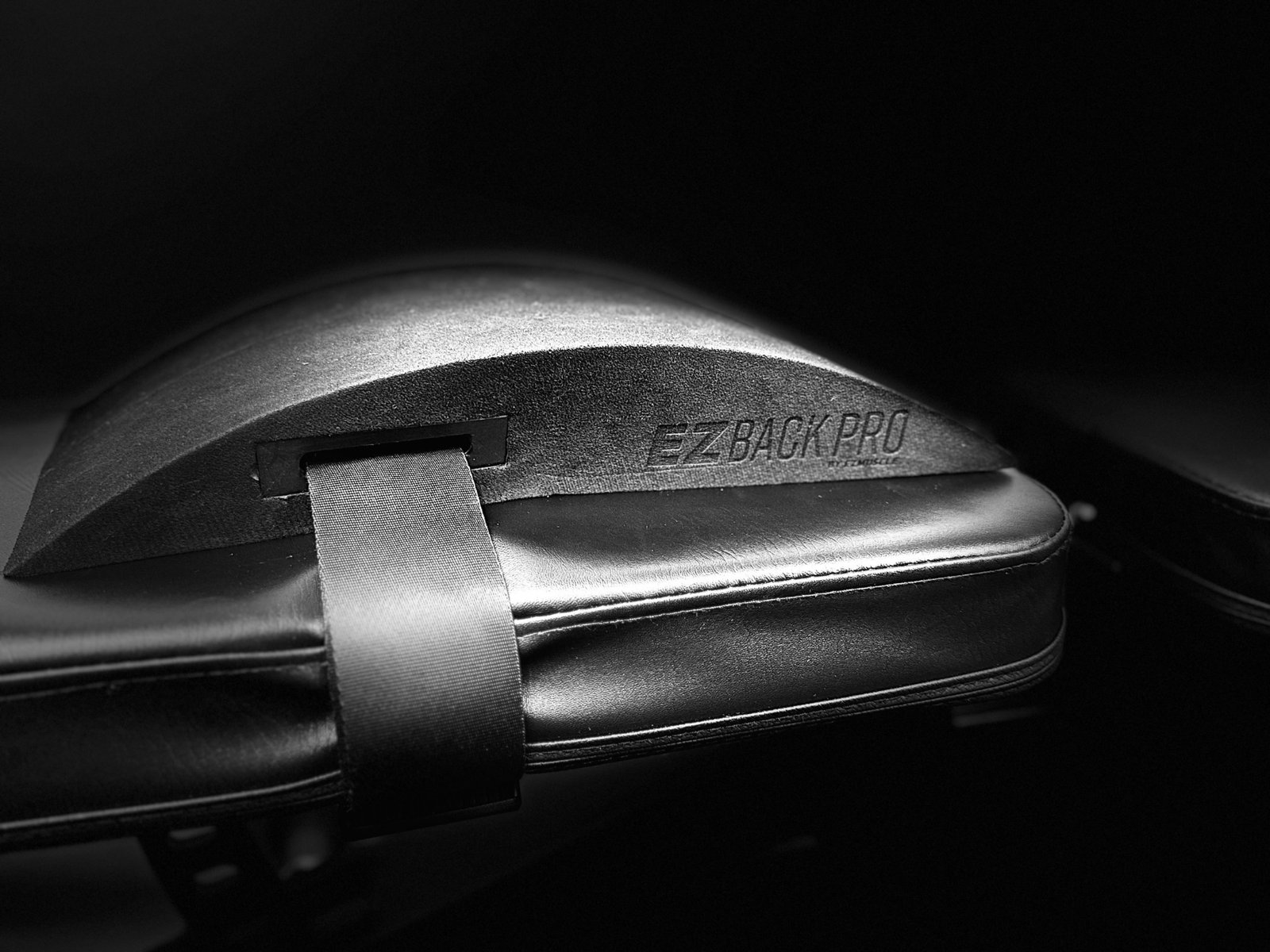
EZBack Pro’s role is not to ‘create’ an arch for you. Its role is to provide a consistent contact reference so your upper back platform stays stable as you unrack, descend, and press.
In practice: strap it securely, set your upper back, and keep contact. Whether you bench flat-back or arched-back, the cue is the same: don’t let the shoulders roll forward or the ribs flare uncontrollably as the bar gets heavy.
When you can repeat your contact points, you can build real progress: load increases, technique stays stable, and the bench becomes predictable—in the best way.
Want the simplest setup?
Start with the EZBack Pro guide on the home page and the product overview, then apply the technique steps in this article on your next session.
Local searches & geo pages
If you found EZBack Pro via local search, our Locations pages help search engines connect your region to the product and support resources.
References
APA-style references used to cross-check key claims.
- Bartolomei, S., Caroli, E., Coloretti, V., Rosaci, G., Cortesi, M., & Coratella, G. (2024). Flat-back vs. arched-back bench press: Examining the different techniques performed by power athletes. Journal of Strength and Conditioning Research. (Open-access: PMC11188622).
- Król, H., Golas, A., Sobota, G., Andrzejewski, M., Nowak, M., & Konieczny, M. (2017). Effect of barbell weight on the structure of the flat bench press. Journal of Strength and Conditioning Research, 31(5), 1321–1337. https://doi.org/10.1519/JSC.0000000000001816
- Mausehund, L., Werkhausen, A., Bartsch, J., & Krosshaug, T. (2022). Understanding bench press biomechanics—The necessity of measuring lateral barbell forces. Journal of Strength and Conditioning Research, 36(10), 2685–2695. https://doi.org/10.1519/JSC.0000000000004136
- Lauver, J. D., Cayot, T. E., & Scheuermann, B. W. (2015). Influence of bench angle on upper extremity muscle activation during bench press exercise. European Journal of Sport Science, 16(3), 309–316. https://doi.org/10.1080/17461391.2015.1022605
- van Breda, E., Verwulgen, S., Saeys, W., & Truijen, S. (2017). The effectiveness of tactile feedback in motor learning: A systematic review. PLOS ONE, 12(12), e0189253. https://doi.org/10.1371/journal.pone.0189253