Grip Width, Elbow Angle, and Shoulder Load in the Bench Press: A Practical Evidence Guide
How grip width and elbow angle change the bench press—what the research says, what lifters actually feel, and how to standardize your setup for stronger, safer reps.
Key takeaways
- Focus on repeatable contact points first: feet, glutes, upper back, grip, breath/brace.
- Use one or two cues at a time—too many internal cues can reduce output under load.
- Choose technique variables (arch, grip width, bar path) based on goals, rules, and comfort—then standardize them.
- Stability improves force transfer; small setup changes can produce big performance changes over time.
- EZBack Pro is a performance training aid, not a medical device.
Why grip width changes everything
Grip width looks like a small detail, but it changes the bench press from the ground up: the range of motion (ROM), the bar path you naturally prefer, and how stress is distributed across the shoulder and elbow. In practice, it also changes how stable the lift feels. When lifters say, “this grip feels strong,” they’re describing leverage and repeatability—often without realizing it.
A wider grip generally shortens ROM and can increase the moment at the shoulder, while a narrower grip usually increases ROM and shifts demands toward the elbow extensors. But it’s not a simple wide-vs-narrow morality play. The useful question is: which grip helps you keep the same contact points and press path at challenging loads? Once you can repeat your best rep, you can build it stronger.
Research on grip width shows meaningful differences in muscle activation and joint mechanics, and it’s one of the reasons a one-size-fits-all bench setup doesn’t work (Barnett et al., 1995; Saeterbakken et al., 2017). Your shoulder structure, training history, and the type of benching you do (touch-and-go, paused, competition style) will all interact with grip choice.
Elbow angle: tuck, flare, and the middle ground
Elbow angle is the partner variable to grip width. A very tucked elbow (arms closer to your torso) can reduce shoulder stress for some lifters but may create a longer press and more triceps demand. A very flared elbow (upper arm more perpendicular to the torso) can feel powerful off the chest for some, but may increase anterior shoulder demand—especially if scapular position and rib control are poor.
Most strong, repeatable benches live in the middle: elbows neither jammed to the ribs nor fully flared. The goal is to keep the forearm vertical (or close) at the bottom so force travels through the stack: bar → wrist → elbow → shoulder. If the wrists dump back or the elbows drift under/behind the bar, you leak force and often irritate joints.
Instead of forcing an “ideal” elbow angle, build the angle that matches your grip and bar touch point. A consistent touch point usually creates a consistent elbow angle. Film from the front corner and look for symmetry rep-to-rep.
- Practical cue: “Elbows under wrists” at the bottom.
- Another cue: “Break the bar” to create upper-back tension without overthinking elbow position.
- If you feel pinch at the front of the shoulder, first check scapular stability and rib flare before blaming elbow angle.
Shoulder load, ROM, and performance trade-offs
The best grip is the one that lets you train hard without accumulating predictable joint irritation. That’s not a vague platitude—load management is part of strength. Wider grips can reduce ROM, which can help performance in some contexts, but they can also increase shoulder torque depending on how the lift is executed. Narrower grips can be very shoulder-friendly for some lifters, but they often increase ROM and shift fatigue toward the triceps and elbows.
Technique studies on bench press variations show that changing setup variables alters how the lift is performed and which tissues bear the brunt (Lauver et al., 2015; Saeterbakken et al., 2017). Another line of work highlights that bench press is not purely vertical—lateral forces exist, and technique influences them (Mausehund et al., 2022). The takeaway for lifters: small technique changes can meaningfully change stress.
So don’t just ask, “Which grip feels strongest today?” Ask, “Which grip lets me repeat high-quality reps week after week?” Strength is built on that kind of boring consistency.
How to choose your grip (goal-based rules)
Use these simple rules to select and standardize your grip. They aren’t perfect, but they’re useful.
- Powerlifting / 1RM focus: Start with a moderate-to-wide grip that you can keep stable and that respects federation rules. Prioritize consistent setup and a repeatable touch point.
- Hypertrophy focus: Use a moderate grip that gives you a controllable ROM and lets you feel pec + triceps work without shoulder discomfort. Slightly narrower often works well for many lifters.
- Shoulder history / cautious return: Start moderate-to-narrow, control the eccentric, and add a pause. Progress load slowly while maintaining scapular stability and rib control.
- Sport transfer: Pick the grip that best matches the pressing angles you use in your sport, but keep the same setup ritual each session.
Once you choose a grip, mark it. Use the bar’s rings as a reference or a small tape marker. Treat your grip width as a fixed variable, the same way you treat squat stance.
How to practice: cue stack + progression
Practice isn’t endless reps. Practice is repeating the same rep. Start with a cue stack you can remember under load: one cue for position, one cue for output.
- Position cue: “Shoulders down and back into the pad.”
- Output cue: “Drive the bar up-and-back to lockout.”
- Consistency cue: “Same touch point every rep.”
Use a simple progression block: 4 weeks where you keep grip width fixed, add small load or rep progressions, and film one top set weekly. If the bar path, touch point, and elbow angle are stable, you’re building skill and strength together.
Remember: when loads get heavy, movement structure can shift (Król et al., 2017). That’s normal, but the goal is to keep shifts small.
Where EZBack Pro fits: repeatable back contact
Grip width and elbow angle choices only matter if you can keep your upper back position under load. Many lifters lose their scapular base as the bar gets heavier, which makes the shoulders roll forward and changes elbow angle without them noticing.
A consistent tactile reference point can help you notice those shifts early. When your upper back stays connected, your touch point stays consistent, your bar path becomes repeatable, and your grip width actually ‘behaves’ the same from set to set.
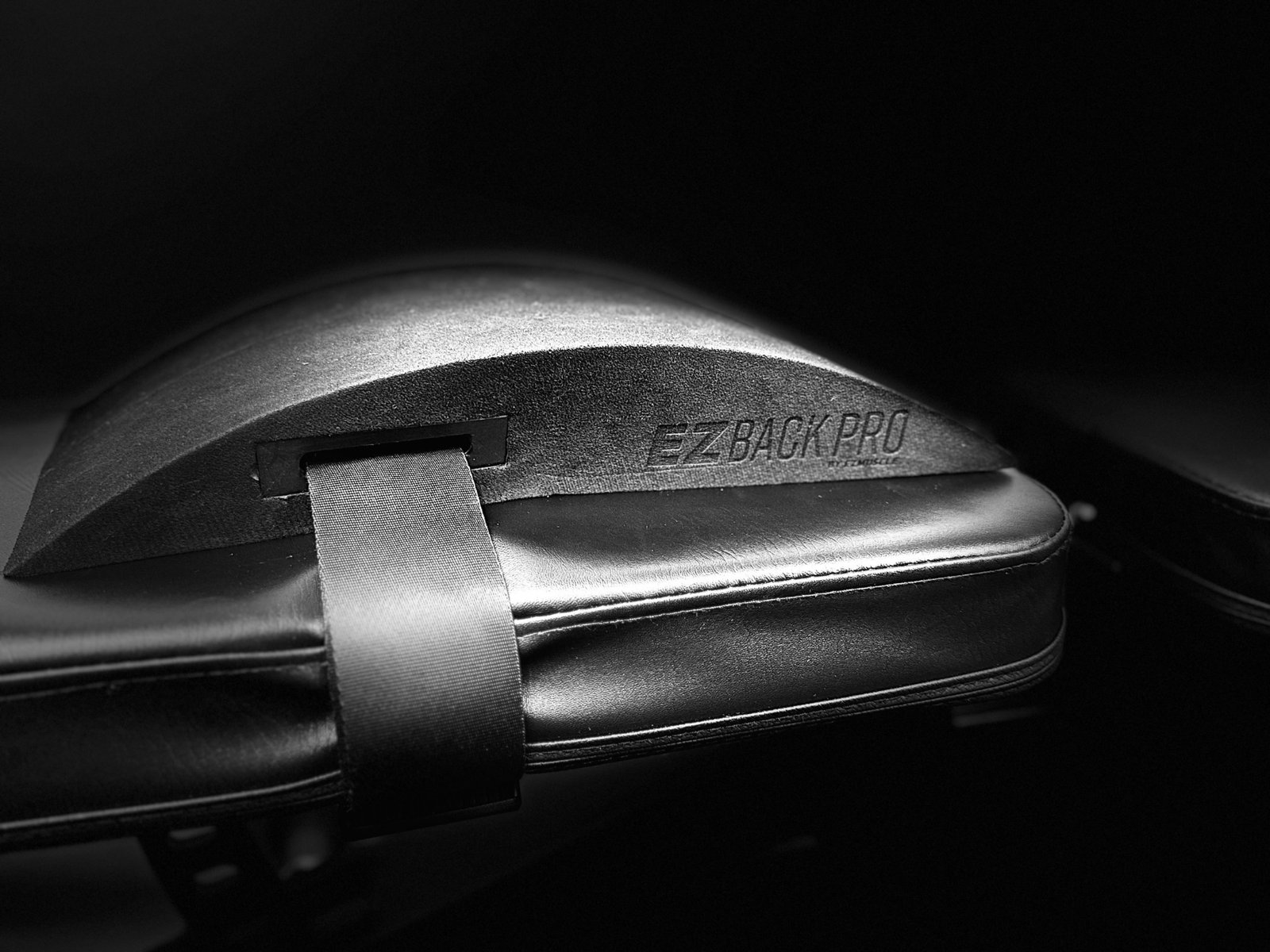
Use EZBack Pro as a training tool: strap it securely, set your upper back before unracking, and keep contact during the eccentric. Treat back contact as a non-negotiable—like feet staying planted.
Want the simplest setup?
Start with the EZBack Pro guide on the home page and the product overview, then apply the technique steps in this article on your next session.
Local searches & geo pages
If you found EZBack Pro via local search, our Locations pages help search engines connect your region to the product and support resources.
References
APA-style references used to cross-check key claims.
- Barnett, C., Kippers, V., & Turner, P. (1995). Effects of variations of the bench press exercise on the EMG activity of five shoulder muscles. Journal of Strength and Conditioning Research, 9(4), 222–227.
- Lauver, J. D., Cayot, T. E., & Scheuermann, B. W. (2015). Influence of bench angle on upper extremity muscle activation during bench press exercise. European Journal of Sport Science, 16(3), 309–316. https://doi.org/10.1080/17461391.2015.1022605
- Mausehund, L., Werkhausen, A., Bartsch, J., & Krosshaug, T. (2022). Understanding bench press biomechanics—The necessity of measuring lateral barbell forces. Journal of Strength and Conditioning Research, 36(10), 2685–2695. https://doi.org/10.1519/JSC.0000000000004136
- Saeterbakken, A. H., van den Tillaar, R., & Fimland, M. S. (2017). A comparison of muscle activity and 1-RM strength of three chest-press exercises with different stability requirements. Journal of Sports Sciences, 35(5), 426–432. https://doi.org/10.1080/02640414.2016.1161216
- Król, H., Golas, A., Sobota, G., Andrzejewski, M., Nowak, M., & Konieczny, M. (2017). Effect of barbell weight on the structure of the flat bench press. Journal of Strength and Conditioning Research, 31(5), 1321–1337. https://doi.org/10.1519/JSC.0000000000001816