Stable vs. Unstable Pressing: What the Research Says About Force Output, Muscle Activation, and Real-World Strength
Instability can increase ‘effort’ but often reduces force and power. Here’s what studies show—and how to use stability tools to improve, not dilute, your pressing.
Key takeaways
- Focus on repeatable contact points first: feet, glutes, upper back, grip, breath/brace.
- Use one or two cues at a time—too many internal cues can reduce output under load.
- Choose technique variables (arch, grip width, bar path) based on goals, rules, and comfort—then standardize them.
- Stability improves force transfer; small setup changes can produce big performance changes over time.
- EZBack Pro is a performance training aid, not a medical device.
What counts as instability
‘Instability training’ can mean many things: Swiss balls, wobble boards, unstable handles, suspension straps, or simply pressing with less back contact and fewer fixed points. The common thread is that the body has to spend more resources controlling position. That control can be valuable in some contexts—but it usually comes with a trade-off: you can’t produce as much force when your platform is moving.
In pressing, stability is largely created by contact points: feet into the floor, upper back into the bench, hands gripping the bar, and a predictable bar path. When any of those become inconsistent, your nervous system prioritizes balance and control. That’s not weakness—it’s survival. But it means your ‘strength’ output in that moment is lower.
Force and power: why performance drops
If your goal is maximal strength or hypertrophy, you need high-quality mechanical tension. Instability often reduces the load you can handle and can reduce peak force and power production. Multiple studies comparing stable and unstable press variations report decreases in force, power, or 1RM performance when stability demands increase (Saeterbakken et al., 2017; Marquina et al., 2023).
This is the core idea: the body has limited bandwidth. When more bandwidth is spent stabilizing, less is available for driving the implement. You can feel like you’re working harder on an unstable surface while actually producing less useful output.
A useful way to think about this is the ‘degrees of freedom’ problem. Under instability, the nervous system must control more moving parts. That increases co-contraction and stiffness demands, which can be useful for joint control but tends to blunt peak expression. In studies where lifters press on unstable implements, the limiting factor is often not pec or triceps strength—it’s the ability to keep the bar or body from drifting.
Muscle activation myths vs. data
People often justify instability training by saying it ‘activates more muscles.’ Sometimes EMG readings do change, but higher activation doesn’t automatically equal better training stimulus—especially if the load is dramatically lower.
Research comparing press variations with different stability requirements shows that instability can shift muscle activity patterns, but usually at the cost of reduced maximal strength expression (Saeterbakken et al., 2017). In other words, you may recruit more stabilizers, but you often can’t load the prime movers as heavily.
If your main goal is pec/triceps hypertrophy or max strength, the simplest strategy is usually: keep the press stable, load it progressively, and use accessory work to address stability where needed.
For hypertrophy specifically, the key driver is typically training volume at meaningful intensity with good technique. If instability forces you to cut load drastically, you may need many more sets to achieve the same stimulus. That can be fine for accessories, but it’s usually inefficient for the primary press.
When instability is useful (and when it isn’t)
Instability isn’t ‘bad.’ It’s just specific. It can be useful for:
- Early-stage return to training where loads must be low but positional control is being rebuilt (with professional guidance).
- Accessory work for scapular control, rotator cuff endurance, and trunk stiffness—when loads are intentionally submaximal.
- Athletes whose sport includes unpredictable contact or position changes (again: as a supplement, not the main strength builder).
But for most lifters, instability is a poor substitute for progressive pressing. If your bench numbers matter, your training needs repeatability: stable setup, consistent bar path, and measurable progression. The ACSM position stand emphasizes progressive overload and structured progression as core principles in resistance training programs (American College of Sports Medicine, 2009).
If you’ve ever had a session where your bench felt ‘wobbly,’ you’ve experienced instability without any fancy equipment. A slippery bench pad, inconsistent foot placement, or a rushed unrack can create enough positional noise to reduce performance. The fix is usually boring: slow down your setup, standardize grip and touch point, and keep the upper back anchored from unrack to rack.
Applying it to bench press training
Here’s a simple decision rule:
- Main lift: keep it stable (barbell bench on a stable bench, consistent setup, repeatable touch point).
- Secondary lift: you can add slight variation (close grip, incline, paused reps, tempo). These keep the platform stable while changing the stimulus.
- Accessory stability work: add instability only if it targets a clear weakness and doesn’t replace the main progressive work.
If you want the ‘feel’ of more stability work without losing output, prioritize stability at the contact points: stronger leg drive, better upper-back tension, and a grip that doesn’t slip. Small changes in setup can produce big changes in consistency and strength expression.
When loads get heavy, movement structure can shift (Król et al., 2017). The goal is to minimize unpredictable shifts by keeping the platform consistent.
Using EZBack Pro to increase repeatability
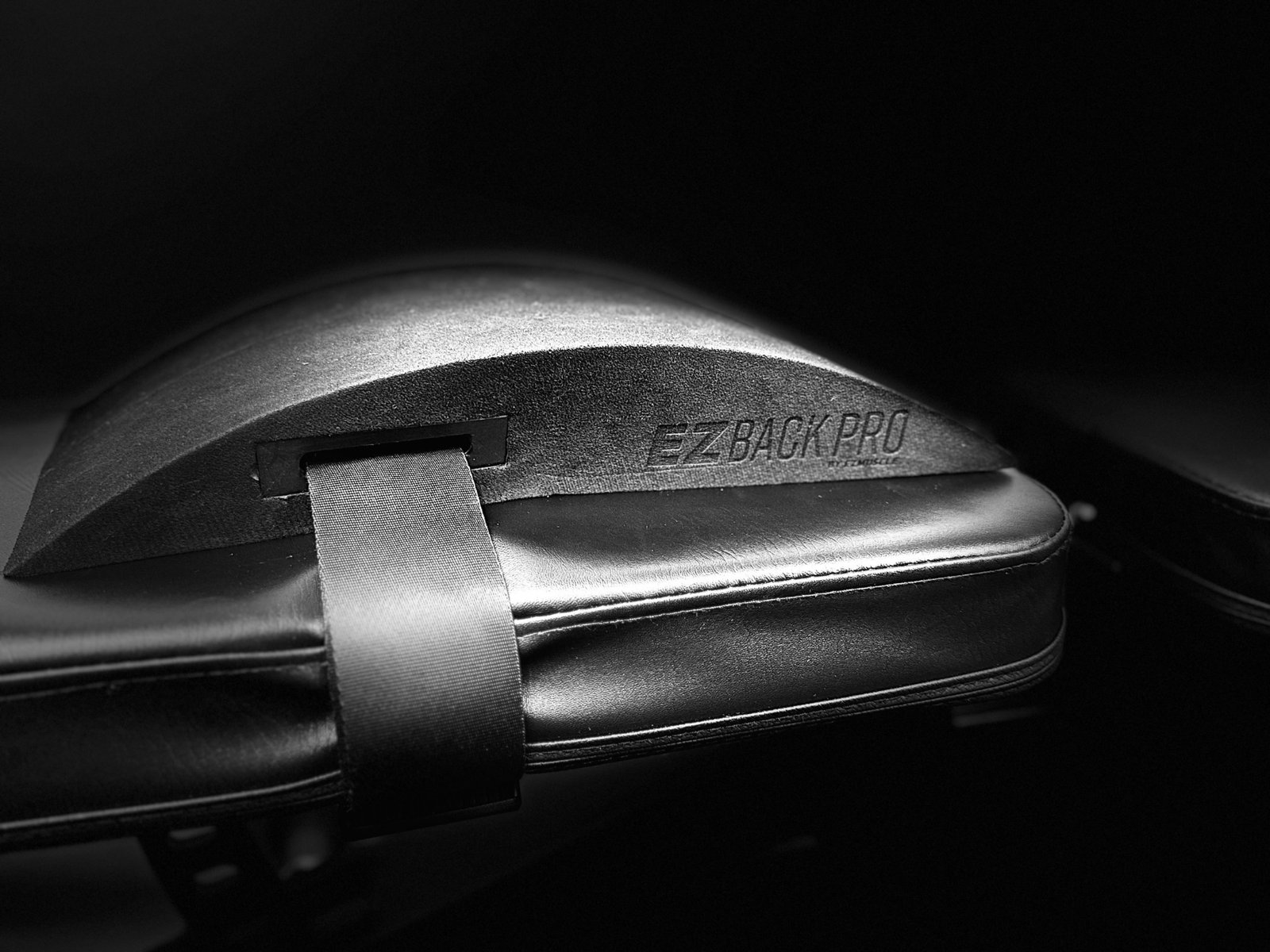
EZBack Pro sits on the ‘stability’ side of the equation: it’s meant to help you feel a consistent back contact reference so your setup doesn’t drift. Instead of adding random instability, it helps you standardize the platform you press from.
That’s useful because it makes your training measurable: if your contact points are the same, you can interpret performance changes more accurately. Better stability means better force transfer, which is the whole point of strength training.
Use it in practice blocks: 4–6 weeks of consistent setup, film periodic sets, and treat repeatability as a skill.
Want the simplest setup?
Start with the EZBack Pro guide on the home page and the product overview, then apply the technique steps in this article on your next session.
Local searches & geo pages
If you found EZBack Pro via local search, our Locations pages help search engines connect your region to the product and support resources.
References
APA-style references used to cross-check key claims.
- American College of Sports Medicine. (2009). American College of Sports Medicine position stand: Progression models in resistance training for healthy adults. Medicine & Science in Sports & Exercise, 41(3), 687–708. https://doi.org/10.1249/MSS.0b013e3181915670
- Marquina, M., Martín-Rodríguez, S., & González-Ravé, J. M. (2023). Effects of instability on upper-limb strength and power performance: A systematic review. Sports, 11(2), 34. https://doi.org/10.3390/sports11020034
- Saeterbakken, A. H., van den Tillaar, R., & Fimland, M. S. (2017). A comparison of muscle activity and 1-RM strength of three chest-press exercises with different stability requirements. Journal of Sports Sciences, 35(5), 426–432. https://doi.org/10.1080/02640414.2016.1161216
- Behm, D. G., & Anderson, K. (2006). The role of instability with resistance training. Journal of Strength and Conditioning Research, 20(3), 716–722. https://doi.org/10.1519/R-18424.1
- Król, H., Golas, A., Sobota, G., Andrzejewski, M., Nowak, M., & Konieczny, M. (2017). Effect of barbell weight on the structure of the flat bench press. Journal of Strength and Conditioning Research, 31(5), 1321–1337. https://doi.org/10.1519/JSC.0000000000001816